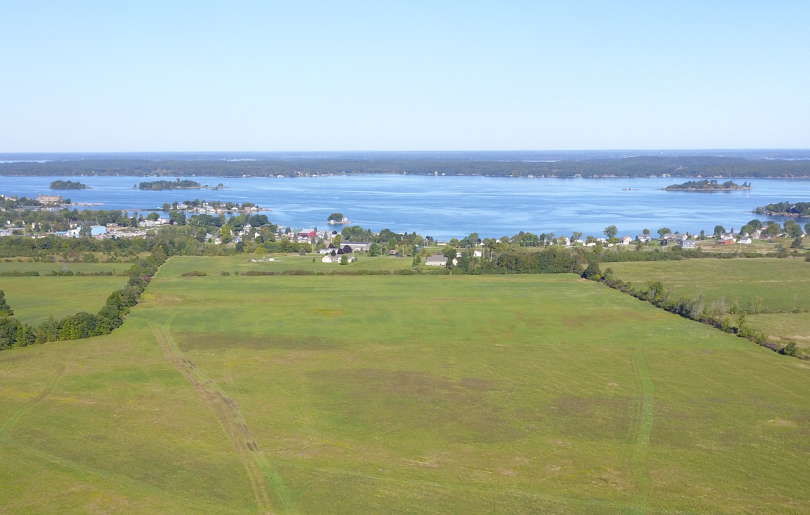
At Carrier Ridge in the Village of Clayton, rolling open fields stretch across nearly 200 acres, creating rare and increasingly important habitat for grassland birds and birds of prey. This December, working alongside the Cantwell Family, the Thousand Islands Land Trust (TILT) conserved the Carrier Ridge property, an acquisition that protects both the natural landscape and the long-term environmental and economic interests of the surrounding community.
The conservation of Carrier Ridge was made possible through Water Quality Improvement Project funding, in partnership with Magnolia Partners, and through the generosity and shared vision of the Cantwell Family. The project builds upon TILT’s existing Rivergate Trail and the S. Gerald Ingerson Preserve, creating a expanded, more connected conservation complex that balances environmental protection with thoughtful community development.
Carrier Ridge’s expansive grasslands support a suite of declining grassland bird species, as well as raptors that rely on open landscapes for hunting and nesting. Protecting these fields ensures that this rare habitat remains intact at a time when grassland ecosystems are among the most threatened in the Northeast. This in return provides a permanent wildlife sanctuary, allowing countless species to thrive.
Beyond its ecological value, the Carrier Ridge project delivers tangible benefits to the local community. Conserving the open landscape helps safeguard water quality that flows into Carrier Bay, maintain Clayton’s scenic backdrop and visual character, and support a healthy balance between the natural and built environment. Importantly, the project also contributes to stabilizing the local tax base. A recent subdivision on this tract will host several new River-view homes, which will remain on the tax rolls. In addition, research consistently shows that proximity to conserved open space enhances property values over time, helping support and stabilize the local tax base.
A regional economic analysis conducted by the Trust for Public Land and peer reviewed by Clarkson University underscores these benefits. The study demonstrates that preserves, trails, and conserved open spaces are economic drivers—enhancing property values, attracting visitors, and generating long-term fiscal benefits for local municipalities.
“The conservation of Carrier Ridge is not only an environmental win—it’s a smart economic investment for the community,” said Jake Tibbles, Executive Director of the Thousand Islands Land Trust. “Protected open spaces strengthen local economies by increasing nearby property values, therefore supporting municipal tax bases, and attracting people who want to live, work, and invest in places that value both natural beauty and quality of life. Carrier Ridge is the perfect example of smart development”
By conserving Carrier Ridge, TILT is reinforcing a proven model: protecting critical natural resources while strengthening community vitality and long-term economic resilience. The project also reflects a shared, forward-looking vision with the Cantwell Family, who sought to see the land conserved as part of their family’s legacy in the Thousand Islands.
“Our family has been fortunate to steward this land for generations, and protecting most of it felt like the right next chapter,” reflected Lorraine Rogers, on behalf of Carrier Ridge LLC. “Preserving habitat for wildlife while keeping the open, rural character of the North Country is incredibly important to us, and we’re grateful to work with TILT to ensure this property remains part of that landscape.”
Looking ahead, Carrier Ridge offers exciting potential for future recreational opportunities that align with habitat protection and community access. As part of a growing network of conserved lands connected to the Rivergate Trail and the S. Gerald Ingerson Preserve, the property enhances landscape-scale conservation while expanding the region’s outdoor assets.
Over the coming months, TILT will begin additional planning to guide stewardship of the property and explore opportunities that support wildlife, water quality, and compatible public enjoyment.