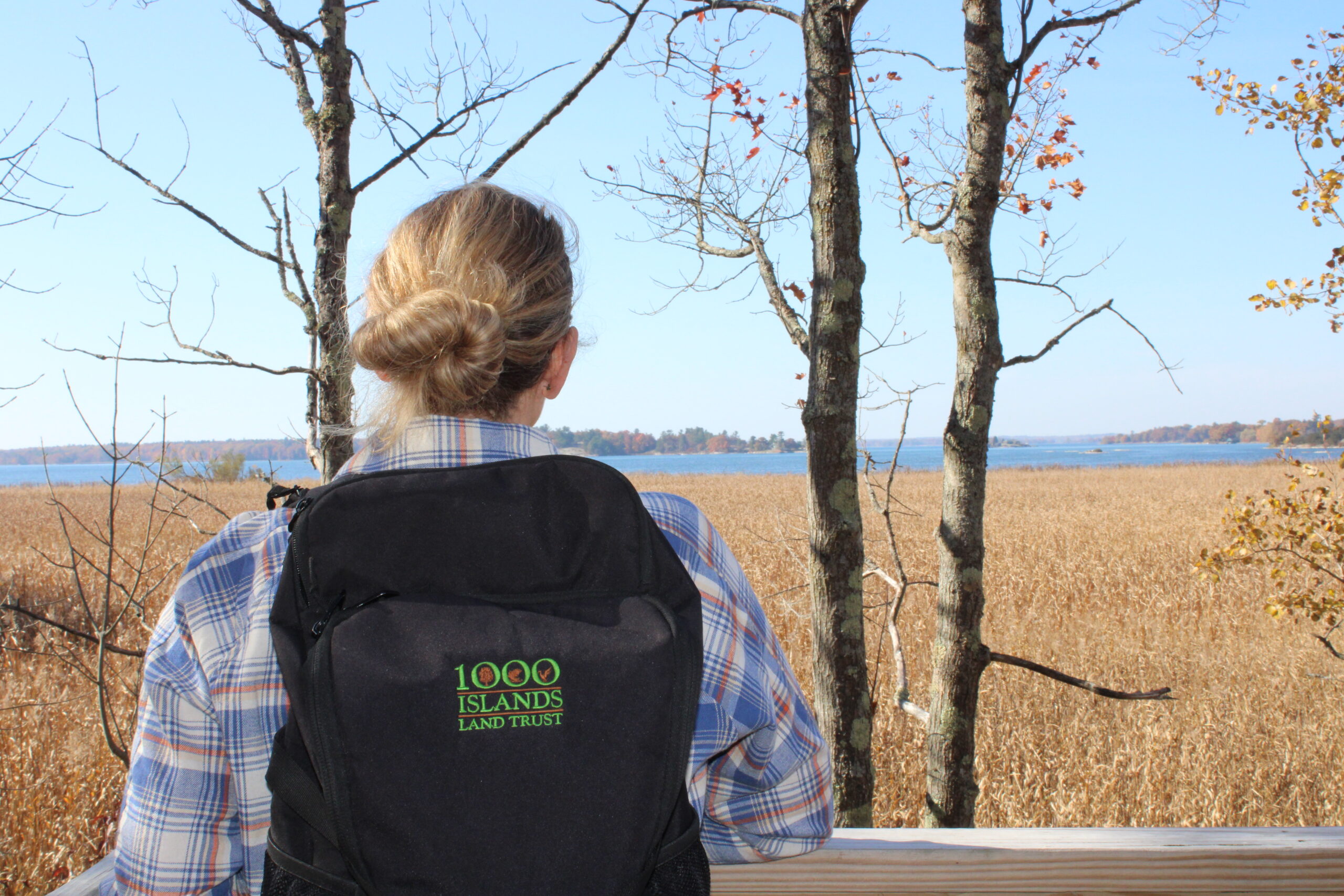
As part of its 40th Anniversary, the Thousand Islands Land Trust (TILT) is highlighting its Signature Preserves—each with a unique story of conservation and community. This month, we’re shinning a spotlight on Chippewa Bay Preserve, a hidden gem that offers a glimpse into the wild, lesser-tamed side of the St. Lawrence River.
Donated to the Land Trust by long-time conservationist and former Board Member Allan Newell, the 72-acre Preserve stands as a reflection of his commitment to land protection. For decades, Allan has carefully stewarded a nearby network of conserved lands creating a “conservation complex” that safeguards critical wildlife corridors and provides refuge for countless species. His gift of the Chippewa Bay Preserve ensured that this unique landscape would remain “forever wild,” managed for low-impact recreation such as walking and cross-country skiing while preserving the area’s natural character.
The property itself is a fascinating blend of geology, history, and habitat. Resting on a sandstone ridgeline at the northern edge of the Frontenac Arch, the Preserve lies within the Algonquin to Adirondacks (A2A) corridor, a vital migration pathway connecting New York’s Adirondacks to Canada’s Algonquin Park. “A visit to this Preserve and hike along its trail offers an up-close experience of the rock outcroppings that define this landscape,” said Spencer Busler, TILT’s Assistant Director. “The land transitions from a young pioneer forest on the upper plateau—once open pasture for cattle grazing—to mature hardwood oaks and hickory along the lower slopes.” At the base lies a Class 1 wetland, teeming with life and recognized as among the highest conservation priorities in New York State.
These wetlands and forested islands provide critical habitat for species like the Blanding’s turtle, American Bittern, and many neotropical migratory birds, like the Cerulean Warbler. They also serve as a natural buffer between upland agricultural areas and the waters of the St. Lawrence, protecting water quality and sustaining fish spawning grounds.
A nod to the land’s agricultural past still exists beneath Route 12, where an old cattle underpass once allowed livestock to move safely between pastures. Today, this “wildlife highway” connects the Chippewa Bay Preserve with the Newell Conservation Area across the road, providing safe passage for deer, foxes, bobcats, raccoons, and other species. Being centrally located within the Algonquin to Adirondacks (A2A) corridor, the Preserve plays a vital role in maintaining cross-border wildlife movement and ecological connectivity between the Adirondack Mountains and Algonquin Provincial Park. What was once built for cattle now serves as a crucial link in this larger landscape, helping wildlife navigate between protected areas on both sides of the border. Wildlife cameras capture the steady rhythm of nature at work—from deer slipping through at dawn to foxes on the evening prowl—showing how local conservation efforts contribute to continental-scale connectivity.
In 2016, with support from a Land Trust Alliance (LTA) grant, TILT built the first official trail through the property—marking the moment the Chippewa Bay Preserve was formally established as a public access preserve. What had long been protected as wild land was now thoughtfully opened for the community to explore and appreciate. The trail was designed for low-impact recreation, allowing visitors to experience the property’s rich variety of habitats without disturbing its delicate ecosystems. As hikers make their way through upland forest and along wetland edges, they’re met with sweeping views of the marsh and the calls of secretive birds hidden among the reeds, a reminder of the diversity this preserved landscape sustains.
For Allan, the land represents the best of both worlds—the rugged cliffs and hardwood uplands, and the quiet, low-lying marsh where wildlife thrives. “It’s a good wild area and part of the Frontenac Arch,” he shared. “I’ve always liked the variety of forest and how biodiverse it is. The deer like to forage on the red cedar, and it’s just a good refuge for everything out there.”
Today, the Chippewa Bay Preserve remains the only public hiking trail and conservation area open to the public in Chippewa Bay, inviting visitors to experience its beauty in every season. Whether you come for a quiet walk, a cross-country ski, or simply to observe wildlife, the Preserve offers a peaceful escape.
Stay active this fall and explore the beauty of TILT’s Signature Preserves, and celebrate 40 years of conservation. For more details and other Preserves to visit this season, head to tilandtrust.org or follow us on social media. Get outside and experience the wonder of fall—we can’t wait to see you on the trails!