By Spencer Busler
Safeguarding Beauty and Wildlife
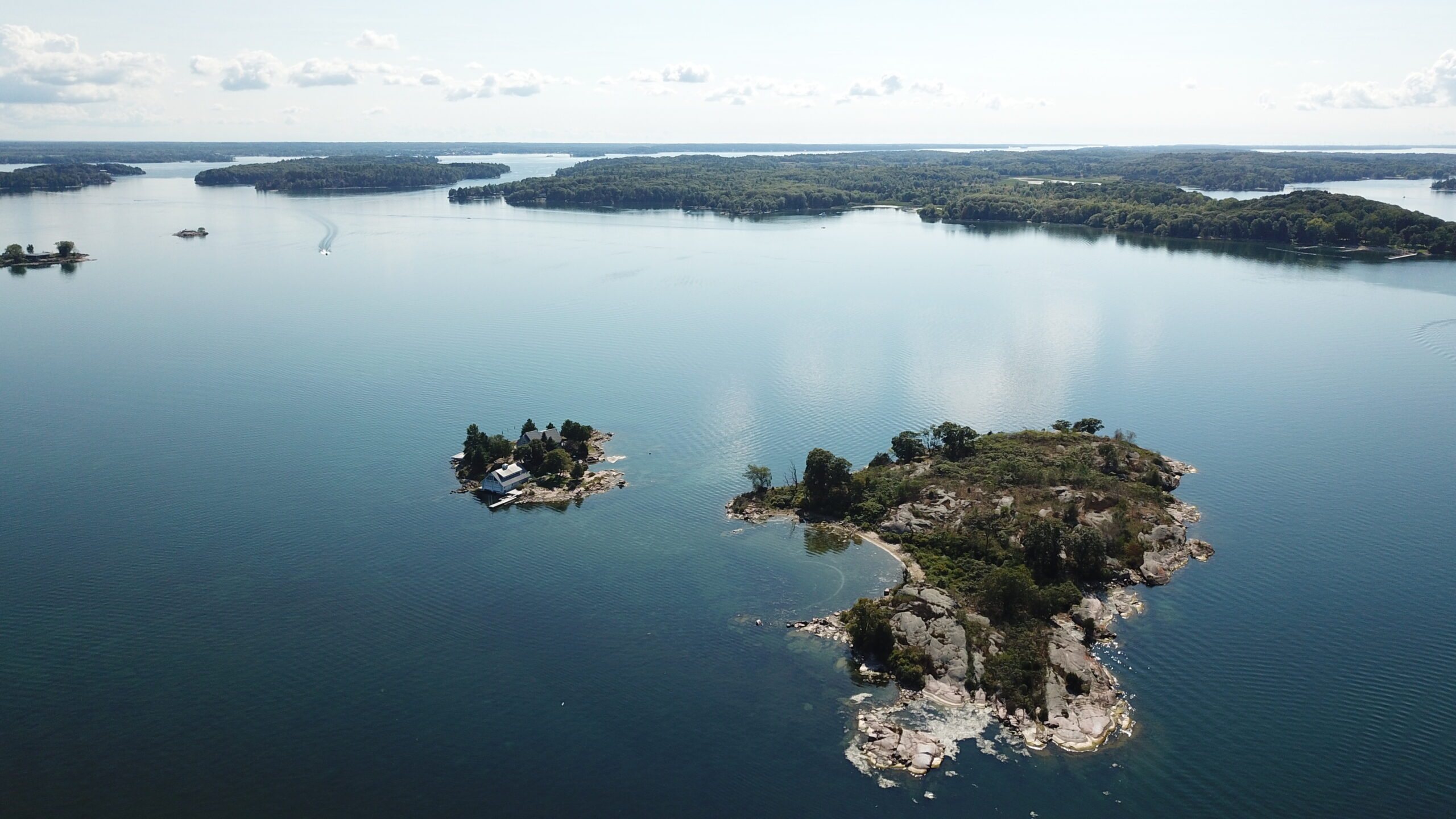
Just 1,864 feet from the international border, Robinson Group’s Big Island offers one of the most commanding views of the St. Lawrence River. It’s a fitting echo of the 1,864 islands that form this remarkable region.
From its rocky pinnacle, the scenery unfolds in every direction. A clockwise scan yields the rosy quarries of Picton Island, the towering forests on the foot of Grindstone, and the shimmering Canadian Lake Fleet chain of islands. The view continues across the ancient hardwood canopy over Grand View Park, into the tropical hues of the Eel Bay shallows, and the pristine shorelines of Wellesley Island State Park’s Minna Anthony Common Nature Center. The eye finally settles on the sheer bluffs of the familiar Murray Isle cut. Together, these vistas compose a natural panorama that could be described as one of the “Seven Wonders of the Thousand Islands.”
This year, the Land Trust secured the permanent protection of Big Island. Thanks to critical support from the Great Lakes Restoration Initiative (GLRI), the New York State Department of Environmental Conservation’s Water Quality Improvement Program (WQIP), and the generosity of the Kreckman and Rogers families, who conveyed the property through a bargain sale, the island will remain in its natural state for generations to come.
Although modest in size at just five acres, Big Island holds tremendous ecological and scenic value. Its 2,300 feet of shoreline provide essential habitat for a wide array of species. Each autumn, thousands of waterfowl—Long-tailed Ducks, Redheads, Canvasbacks, Greater and Lesser Scaup, Common Goldeneyes, and Common Loons—gather in the sheltered waters of Eel Bay. In summer, terns nest along its rocky edges, while migrating shorebirds feed across the shallow flats. This is an important stopover along the Atlantic Flyway, a vital corridor for migratory birds. Through its protection, we have conserved an irreplaceable resting and feeding ground within a much larger continental network of habitats.
“There are very few islands of this size and visibility that have remained untrammeled,” noted Jake Tibbles, TILT’s Executive Director. “Conserving natural rarities like this is a major victory for the Thousand Islands region.”
A Forest Steeped in Time, Now Protected
Just a half-mile to the east, TILT reached another milestone this year with the permanent protection of the Buxton Tract. This 7.8-acre property, situated beneath the aged oaks, hickories, and maples of Grand View Park on Wellesley Island, features 230 feet of undeveloped shoreline and abuts Wellesley Island State Park. Made possible by Virginia Buxton through a bargain sale and supported with funding from NYSDEC, it expands the conservation footprint of one of the region’s most visited destinations while conserving a vulnerable parcel that might otherwise have been fragmented.
Ecologically, this property strengthens habitat connectivity and water quality in Eel Bay. Its mature forest and natural shoreline provide critical habitat for birds such as the Black-billed Cuckoo and Belted Kingfisher, while also serving as an important waystation for monarch butterflies.
Since monarchs travel thousands of miles during their migration, these rest stops help them survive the arduous journey. The conservation of this tract prevents shoreline disturbance and safeguards the riparian buffer vegetation that filters runoff, reduces erosion, and maintains the health of the St. Lawrence River. Together, the protection of Big Island and the Buxton Tract represents a major step forward for conservation in Eel Bay. In a region where undeveloped islands and shorelines are increasingly rare, these properties will remain permanently conserved. Their protection is a lasting gift for the wildlife that depends on them, and the people who cherish the Thousand Islands for its beauty, recreation, and the unique character that makes this region so special.
Such victories remind us that conservation is both urgent and achievable. Development pressures continue to mount throughout the Thousand Islands, yet with the dedication of landowners, and the commitment of partners and organizations like TILT, critical properties can still be protected—striking a balance between conserving natural landscapes and supporting the communities that rely on them.
The Land Trust has long recognized that shoreline conservation is one of the most effective ways to protect the River. Healthy riparian buffers not only preserve natural beauty but also protect water quality, wildlife habitat, and public health. Eel Bay, with its sweeping views and rich wildlife, now holds two more forever-protected landmarks.