Science and Conservation in Action
by Bridgett McCann I Communications Specialist
Morning mist hangs over Blind Bay as a canoe drifts quietly into the shallows. On board, Thousand Islands Biological Station (TIBS) lab manager Andrew Parnas and Thousand Islands Land Trust (TILT) volunteer Owen Trela steady a cooler filled with thousands of young muskellunge— “muskie,” as River locals know them.
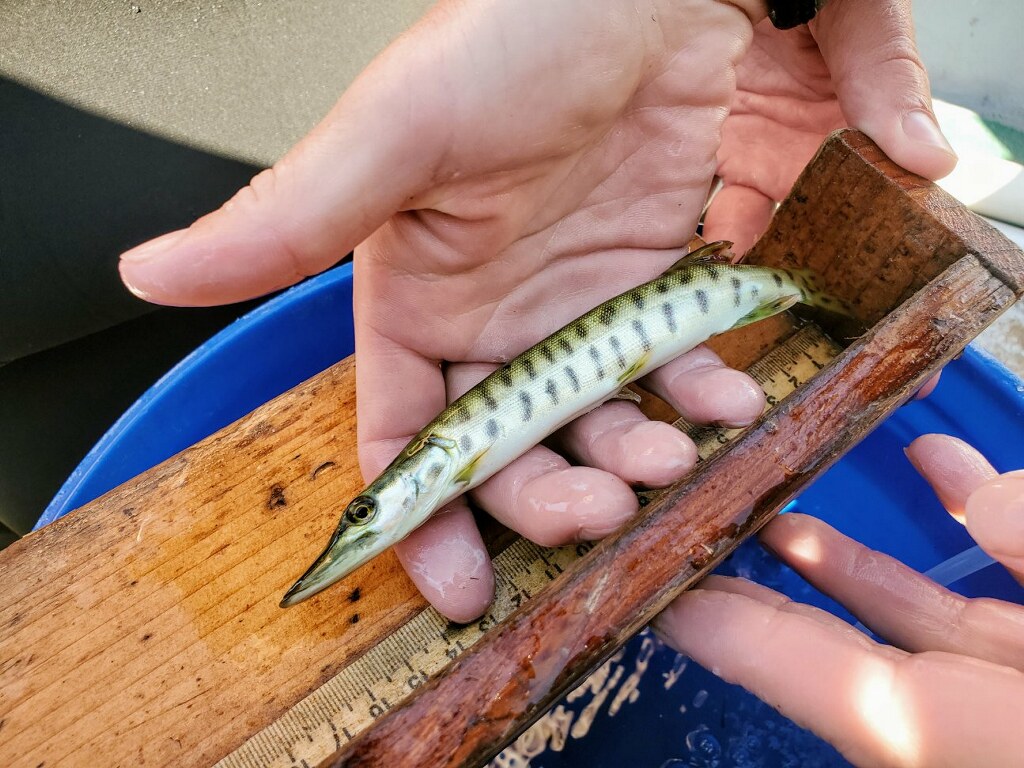
Soon, these fragile fry will leave the lab and slip into the St. Lawrence, part of decades-long efforts to rebuild population of the River’s legendary predator.
Before release, Andrew dips a bucket into the bay and slowly mixes River water into the cooler. “We want to bring the water temperature closer to the River’s,” he explains. “If you just dump them in, the shock makes them vulnerable to predators.”
Few fish inspire reverence like the muskie. Known as the “fish of ten thousand casts,” they are the River’s apex predator, reaching more than 50 inches. But the species has faced severe challenges: in the mid-2000s, Viral Hemorrhagic Septicemia (VHS) and invasive round gobies decimated spawning grounds and preyed on eggs, sharply reducing the population. In response, scientists and conservation partners across the region mobilized to better understand the decline and act to restore the population.
Science Meets Conservation
Just off the shores of downtown Clayton on Governors Island, the Thousand Islands Biological Station grew from Dr. John Farrell’s lifelong passion for the St. Lawrence. Each summer, staff and interns set nets, test water quality, and tag fish with acoustic transmitters to track movements, building decades of data on population trends and habitat needs.
The lab raises thousands of fry annually from eggs collected from adult muskellunge in the River, then rears them in the lab before release. Stocking supports local populations, but the goal remains natural reproduction: “We don’t want to stock forever,” Farrell notes. “Conservation-based stocking helps rebuild populations while habitats recover.”
Research shows young muskies depend on complex coastal wetlands—shallow oxygen-rich bays with vegetation—for shelter and feeding. That’s where conservation becomes critical. Protecting these habitats ensures research translates into recovery.
Long before TILT conserved the property in 2016, Blind Bay Preserve in Clayton served as both a refuge and a living laboratory. In 2025, TIBS documented a spawning pair—a female laden with eggs, and a male nearby—both tagged to track movements and spawning behavior.
Windsong Bay: A Keystone Conservation Property
A key piece of that conservation puzzle is Windsong Bay, a property acquired by TILT in 2025 with support from the U.S. Fish and Wildlife Service (USFWS) Fish Enhancement, Mitigation and Research Fund (FEMRF), the New York Power Authority, and the Town of Waddington.
Like Blind Bay, Windsong provides critical wetlands and shallow bays that serve as spawning habitat for muskellunge. This 106-acre preserve, located just upstream of the Iroquois Control Dam in Waddington, protects a mosaic of wetlands, shoreline, and shallow bays.
Each spring, adult muskies move into these wetlands to reproduce. Research by TIBS and the USFWS shows fish born here can migrate extraordinary distances each year— sometimes as far as Kingston, Ontario. Recently, muskies were tracked swimming the round-trip journey from Windsong Bay to 40 Acre Shoal, highlighting the scale and precision of these seasonal movements.
Windsong’s value extends beyond muskies. Its wetlands filter water, buffer floods, and support biodiversity, providing habitat for American eel, Blanding’s turtles, and grassland birds. By conserving Windsong, TILT ensures this ecologically rich area remains intact, preserving a healthy River corridor that benefits both wildlife and local communities.
Together, science and conservation are rebuilding the River’s iconic predator. TIBS research, habitat protection, and community stewardship are giving muskellunge a renewed chance to thrive.
Conserved wetlands like Windsong Bay (Waddington), and Flynn and Blind Bay (Clayton) now serve as nurseries and living laboratories, proving that recovery is possible when research and land protection work hand in hand.