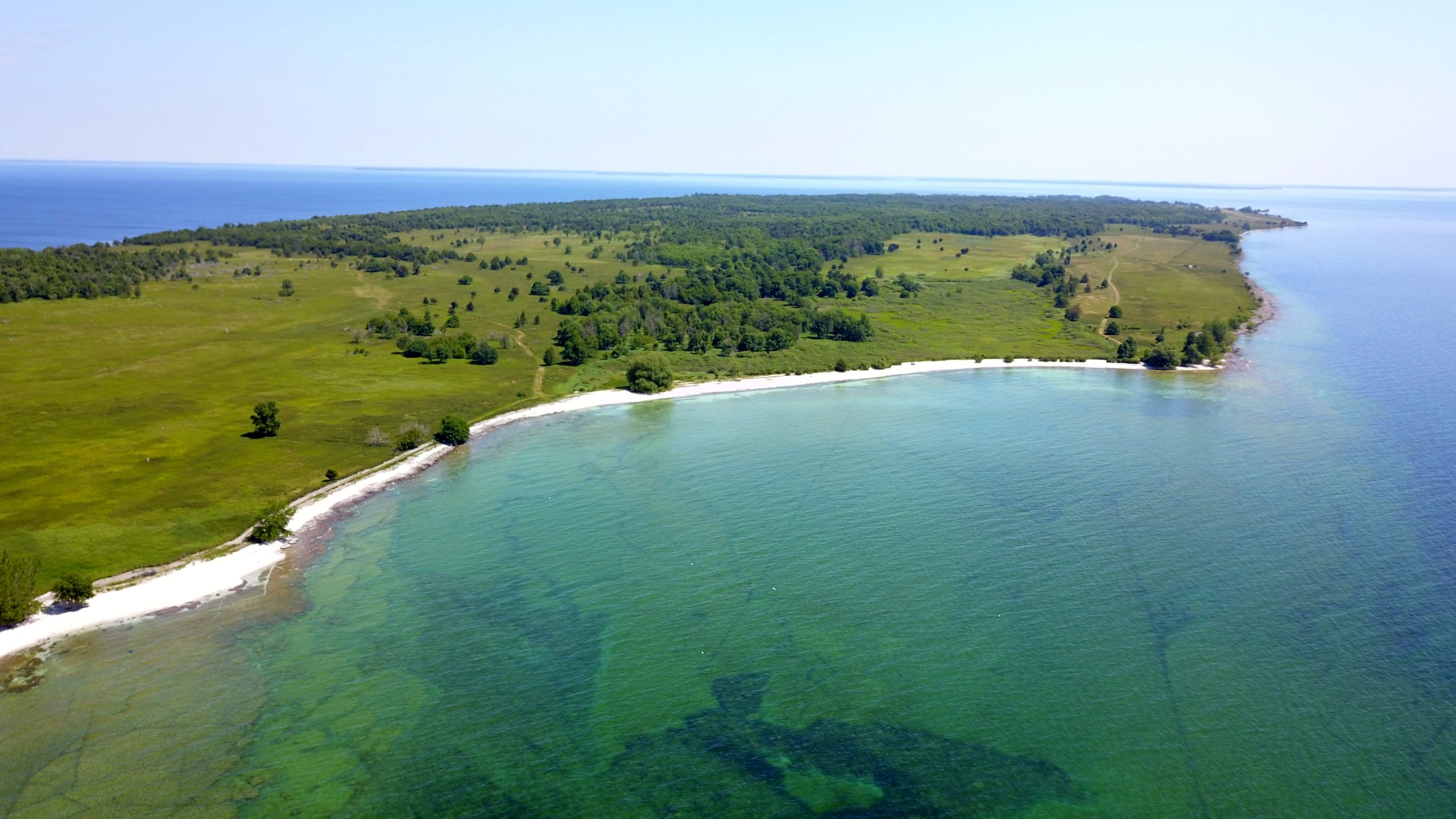
The Thousand Islands Land Trust (TILT) has permanently protected 1,410 acres on Galloo Island through a conservation easement, marking the largest conservation project by acreage in the organization’s 41-year history. A conservation easement is a voluntary agreement that protects land from future impacts while allowing it to remain privately owned. On Galloo Island, it will help safeguard the Island’s forests, wetlands, meadows and shoreline now, and for generations to come.
Located in Lake Ontario in the Town of Hounsfield, Galloo Island is a remarkable coastal landscape and one of the region’s most significant places for conservation. The conservation easement protects approximately 70% of the property’s 2,000 acres, including roughly five miles of undeveloped shoreline and a diverse collection of habitats that support an abundance of wildlife.
“Galloo Island is a remarkable place, and protecting it is a tremendous accomplishment for TILT and for the region,” said Jake Tibbles, Executive Director of TILT. “Galloo’s location along the Atlantic Flyway makes it especially important for migratory birds, providing a place to rest, feed and nest during their journeys. By protecting the Island’s forests, wetlands, meadows and undeveloped shoreline, we’re helping secure an important piece of habitat for wildlife and an important part of the Lake Ontario landscape.”
The Island supports a wide variety of wildlife, including bald eagles, upland sandpipers, short-eared owls, northern harriers and common terns, as well as numerous species of songbirds, shorebirds, waterfowl, raptors and other water-dependent birds. Its diverse habitats include successional meadow, sedge meadow, barrier-beach wetland, red maple swamp, hemlock-hardwood swamp and emergent coastal marsh. Galloo Island’s location along the Duck-Galloo Ridge, a geological feature extending through the eastern end of Lake Ontario, further contributes to the Island’s ecological significance.
Galloo is also a place where natural and cultural history are closely intertwined. The Island once supported cedar shingle mills, with cedar cut into shingles and shipped to the mainland for homes throughout the region. In the late 1800s, the Galloo Island Fortnightly Club, also known as the P-K Fishing Club, brought prominent visitors to the Island and established a tradition of fishing and recreation that continues in different forms today. Notable visitors who came to the Island for recreation included U.S. Secretaries of State John Watson Foster, Robert M. Lansing, and John Foster Dulles. The Island’s history also includes its lighthouse, first illuminated in 1820 and the first lighthouse built by the United States on Lake Ontario.
Today, Galloo remains an important destination for recreational fishing, with North Bay serving as a popular shore-lunch location for fishing guides from throughout the region. Protecting Galloo’s undeveloped shoreline and coastal habitats helps protect water quality and the nearshore waters that support Lake Ontario’s renowned bass fishery.
The conservation easement also helps protect water quality along Galloo Island’s extensive undeveloped shoreline. By limiting future disturbance on the protected acreage, the easement helps preserve the natural riparian buffers along of Lake Ontario.
While the easement permanently protects a large portion of Galloo Island, the remaining portion can continue to support agricultural activities, improvements to existing operations, and is open for potential future development. The property will remain privately owned and on the tax rolls, allowing conservation and continued economic use to coexist.
Galloo Island has a long and distinctive history, with generations of agricultural, recreational and other uses shaping the landscape. In more recent years, the Island was proposed as the site of a large-scale wind energy development. While that proposal ultimately did not move forward, environmental studies conducted during the planning process further documented the Island’s ecological significance, including its importance to birds and other wildlife. New York State Department of Environmental Conservation has described Galloo as the largest generally undeveloped island in Lake Ontario and noted its importance as nesting, feeding and resting habitat for waterfowl and migratory birds.
The Patten family owned the majority of Galloo Island in the late 1980s before parting with the property in 1990. Thirty-one years later, the family reacquired the Island and chose permanent conservation as part of its future.
“There’s something about Galloo that you just can’t put into words,” said Mike Patten, managing member of Galloo Island LLC. “It’s where I find peace, where our family comes together, and where some of our happiest memories have been made. Protecting the Island is our way of making sure what makes this place so special will endure.”
The protection of Galloo Island was made possible through the cooperation of the Island’s landowners and TILT, with funding support from the New York State Department of Environmental Conservation’s Water Quality Improvement Project program.
The conservation of Galloo Island marks the beginning of a longer effort to share the Island’s story. In the coming months, TILT will highlight Galloo’s natural history, wildlife, conservation story and cultural history through its communications channels and partnerships.
Want to read more? Click here to read the article published by the Watertown Daily Times!